If you're a lawn or landscape company considering Google Local Services Ads (LSAs), here's the short answer:
LSAs work when you answer calls fast, have strong reviews, and offer services customers want right now. They struggle when your intake is loose, your service area is too broad, or your team treats calls casually.
Cost varies by market, but the number that matters is not cost per lead. It is cost per booked job and cost per acquired customer. A cheap call that never turns into work is still wasted spend.
Avoiding bad leads mostly comes down to focus. Tighter services, tighter geography, and tighter call handling.
What LSAs Are (And Why They're Different Than Google Ads)
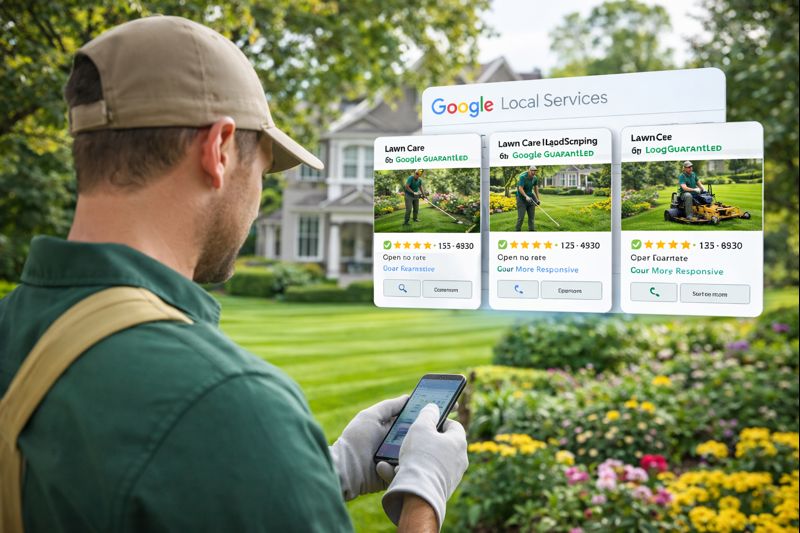
LSAs are the Google Guaranteed or Google Screened listings that often appear above traditional search results. Instead of keyword bidding, you compete inside Google's LSA marketplace, where reviews, responsiveness, proximity, and profile accuracy drive visibility.
Operationally, this matters because LSAs are a call-first channel. If your office struggles to answer or qualify calls, LSAs will expose the weakness quickly.
When LSAs Work Best for Lawn & Landscape Companies
LSAs tend to perform well when you have near-term capacity, consistent call coverage, and services with clear intent. Weekly maintenance, cleanups, landscape installs, irrigation repairs, and similar services typically fit well because customers are actively looking to hire, not just browse.
They are far less effective when you are selling long-horizon work, when your service offering is vague, or when your close rate is weak due to slow follow-up or untracked estimates.
What LSAs Typically Cost (And What Actually Drives Cost)
Pricing is market-driven, but performance is usually dictated by factors you can influence. Category choice, competition density, availability, review strength, and how often you answer calls all affect both cost and lead quality.
Instead of fixating on lead price, evaluate LSAs based on booked estimates, closed deals, revenue per customer, and gross margin. That is how you determine whether LSAs are a growth tool or simply noise.
How to Reduce Bad Leads Without Killing Volume
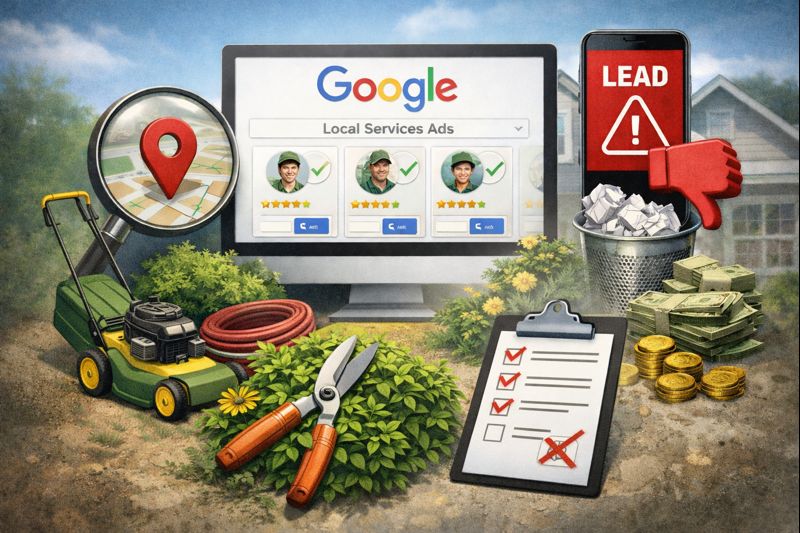
Most bad leads come from being too broad. Start by narrowing what you advertise and where you advertise it. If your profile suggests you do everything everywhere, Google will send exactly that kind of traffic.
Just as important is your intake process. Your office should quickly confirm service area, service fit, and timeline before moving a call forward. Clear qualification protects your schedule and margins without killing lead flow.
"When it comes to LSAs, most bad leads come from being too broad."
The Ranking Factors You Can Actually Control
LSAs are not simply a pay-more, show-more system. Google favors businesses that look reliable and responsive.
You improve performance by:
- Generating consistent reviews — More reviews and higher ratings boost visibility
- Aligning business hours with real call coverage — Don't advertise hours you can't answer
- Answering quickly — Response time directly impacts your ranking
- Disputing truly irrelevant leads when appropriate — Helps Google learn your business
- Keeping your profile accurate and complete — Services, photos, and info all matter
The goal is to make your business the safest recommendation for Google to trust.
Tracking LSAs So You Know What You're Really Buying
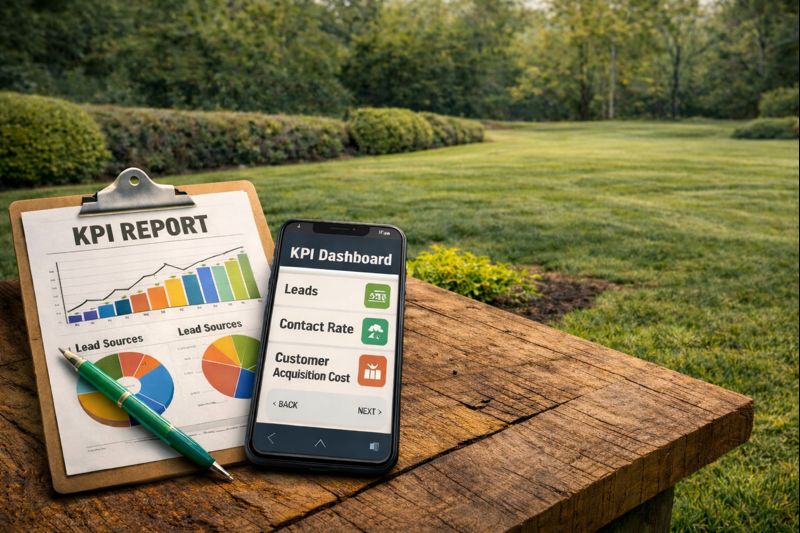
If you only track calls, you will never know if LSAs are working. At minimum, you should know which leads book, which close, and which services produce profitable work.
Track each LSA lead through your pipeline, from call to estimate to close, and review results by service type. If volume is up but margins are down, the fix is almost always better filtering and intake, not more spend.
Want Better LSA Results?
We help lawn and landscape companies turn LSA leads into booked, profitable jobs — not just more phone calls.
Get a ConsultationCommon LSA Mistakes That Waste Budget
The most common issues are:
- Broad categories — Advertising too many services dilutes your relevance
- Oversized service areas — Spreading too thin geographically
- Missed calls — Nothing kills LSA performance faster
- Untrained office staff — Poor call handling wastes good leads
- Judging success by lead count — Instead of booked and profitable jobs
Running LSAs while already overloaded is another frequent mistake. It creates burnout, not growth.
A Simple LSA Readiness Check
Before scaling LSAs, confirm you can:
- Answer calls consistently during business hours
- Clearly identify which services you want to grow
- Understand your profitable service radius
- Have a basic qualifying process for incoming calls
- Track outcomes from lead to close
- Actively collect reviews from satisfied customers
Without those pieces, LSAs tend to underperform.
Need Help Turning LSAs Into Profitable Jobs?
If you are running LSAs, or thinking about it, and want to improve lead quality, tracking, and conversion without overwhelming your team, Lawnline Marketing can help you tighten the system so the channel actually performs.
Call Lawnline Marketing at (813) 944-3400 to talk through what to fix first so LSAs drive booked, profitable work — not just more phone calls.