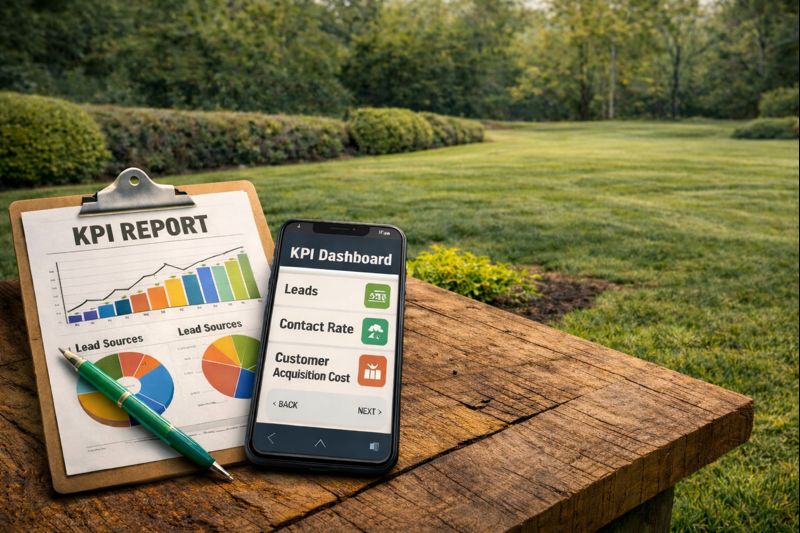
If you're running a seven-figure lawn or landscape company, you don't need 30 dashboards. You need a short monthly scorecard that shows whether marketing is creating demand and whether your sales process is converting that demand into booked work.
To do this, you'll want to review these six KPIs every month: lead volume by channel, speed-to-lead, contact rate, estimate set rate, close rate, and customer acquisition cost (CAC). When one drops, do not guess or immediately increase ad spend. Trace the dip to the step right before it, then fix that constraint first.
Make this practical by reviewing monthly and spot-checking weekly during peak season. Use medians for response time so one rough day does not distort reality. Compare to the last three months and the same month last year to account for seasonality.

1. Lead Volume
Lead volume is the number of new inquiries you receive from phone calls, forms, texts, and sources like LSAs, broken out by channel. It matters because if demand falls, sales cannot convert leads that are not coming in.
When lead volume drops: Verify tracking and coverage before changing spend. Confirm call tracking numbers are working, form notifications are being received, and leads are actually being delivered. Then check the "plumbing" in the office, including missed calls, after-hours handling, and who owns callbacks. Only after those basics are confirmed should you adjust targeting or budget.
2. Speed-to-Lead
Speed-to-lead is the time from inquiry to your first human response attempt. It matters because faster response typically improves contact rate and appointment setting, especially for higher-ticket work.
When speed-to-lead slows down: Remove workflow bottlenecks. Assign clear ownership for responding and a backup plan for coverage. Use a simple response ladder in the first hour that includes a call and then a text and an email if needed. Avoid letting one shared inbox become the gatekeeper for all leads.
3. Contact Rate
Contact rate is the percentage of new leads you actually connect with in a two-way conversation. It matters because a weak contact rate makes every downstream KPI look worse and hides the true issue.
When contact rate drops: Tighten your first touch and your first 24 hours. Make the first message specific and time-bound so the customer can say yes easily. Confirm your caller ID and voicemail are set up correctly since unknown numbers get ignored. Standardize your follow-up attempts in the first 24 to 48 hours so contact is not left to chance.
4. Estimate Set Rate
Estimate set rate is the percentage of contacted leads that book an estimate or consult. It matters because this is where office process turns into revenue capacity.
When estimate set rate drops: Reduce scheduling friction. Offer clearer windows and faster availability, even if it is a limited schedule for high-intent leads. Standardize qualifying questions so you set fewer bad-fit estimates. Segment by service type because some services require quicker site visits to win the job.
5. Close Rate
Close rate is the percentage of estimates that turn into signed work. It matters because it reflects sales execution, offer clarity, and trust.
When close rate drops: Improve clarity and follow-up discipline. Tighten scope and expectations so prospects understand what is included and why it matters. Set a decision date during the estimate so there is a clear next step. Use a defined follow-up cadence over seven days instead of random check-ins that feel like noise.
6. Customer Acquisition Cost (CAC)
Customer acquisition cost is your marketing and sales costs divided by the number of new customers won that month. It matters because CAC tells you whether growth is profitable, not just busy.
When CAC rises: Diagnose conversion before blaming ad costs. Separate cost per lead from CAC because CAC can rise if close rate slips, even when leads are steady. Cut waste by tightening targeting, reducing unqualified estimate volume, and prioritizing the service mix that yields healthy margins. Then, rebalance budget toward the channels and services that produce sold work efficiently.

Make Reporting Easier
Enlisting the help of a digital marketing agency can make reporting and tracking of important KPIs easier than ever.
Learn About Our ReportingWe Help With Reporting and Data Tracking via Our Growth Programs
Keeping a close eye on these 6 KPIs will help you make the best decisions for your marketing. Fortunately, at Lawnline Marketing, we handle all of that via our full-service Growth Programs!
To learn more about how we can help your green industry business, call (813) 944-3400 today.